



Nirvamlet, a roaming theatrical performance mixing 90s grunge and Shakespeare’s Hamlet, begins outdoors under the Denver Performing Arts Complex’s 80 foot tall glass roof. As patrons begin to gather for the 8 PM show on the parking garage’s 4th level, a live band performs 90’s grunge covers to set the mood for the evening’s show. Noticing a handful of overzealous dancers in the audience looking suspiciously like groupies, I begin to wonder if the show has already begun.
Sure enough, as the top of the hour arrives, the pre-show entertainment seamlessly transitions into the main event as actors in the play (and the dancing groupies) begin to emerge from the audience. A car blaring music screeches down the ramp of the parking garage where we’re standing, jumps the curb, and more groupies pile out of the car, some of them stumbling as a result of a few too many pre-game drinks.
Our narrator, Detective Fortinbras, wastes no time in introducing us to the cast of characters we’re about to follow on this “rocktail of icons and heart-shaped depression, with a splash of conspiracy and murder.”
First we meet Courtious. She is female rockstar Courtney Love in this modern day drama, but she is intertwined with parallels to Gertrude, Hamlet’s mother, as well as Claudius, Hamlet’s uncle who killed his father. Courtious enters the stage with Kurt Cobain, giggling, kissing, and unable to keep her hands off of him. But, we’re reminded, it’s present day, and Kurt Cobain is no longer with us. The Kurt we see before us is his ghost.
We quickly learn that Courtious’ son Hamlet is upset and not speaking to her. She calls Rosencrantz and Guildenstern, childhood friends of Hamlet’s, to come help her figure out what’s wrong with him. Meanwhile, we briefly make acquaintance with Polonious and his two children, daughter Ophelia and son Laertes. Polonious in present day is Courtious’ manager, drawing inspiration from Shakespeare’s Polonious, chief counsellor to Hamlet’s deceased father.
Are you confused yet? I sure was. But that’s because they throw a lot of information at you in the first scene, and I was also unfamiliar with the story of Hamlet prior to seeing the show. Perhaps those who knew the story were able to connect the dots easier than I. Still, without that knowledge to draw upon, I was able to make sense of the story unfolding in front of me.
The characters’ names and relationships were Shakespearian, but they were also modernized within the context of the story of Kurt Cobain’s death. And make no mistake about it: this play drew just as heavily from that narrative as it did from Hamlet. It continuously drilled into us the gruesome details surrounding Cobain’s passing, and frequently positioned Love as the arbiter of his death. It was done with enough taste to remain respectful, but it did touch an emotional nerve and worked to push the audience outside of their comfort zone.
When our narrator waves his red bandana, that’s our cue to follow him to the next scene’s location. As we begin to move, the five drunk and stoned concert goers who piled out of the car sing and hum Ozzy’s “Crazy Train” with much enthusiasm as they herd us down the steps and across the Denver Performing Arts Complex. I enjoy a good chuckle as confused on-lookers watch us and the animated actors moving us along.
Get Danielle Riha’s stories in your inbox
Join Medium for free to get updates from this writer.
SubscribeSubscribe
We arrive inside the lobby of the Ellie Caulkins Opera House to find Courtious looking and acting like a hot mess, sprawled out face-down on a bench puffing on a vape pen. A four-person band plays an acoustic version of “Lithium” at the back of the room as we quickly fill in rows of comfortable folding chairs.
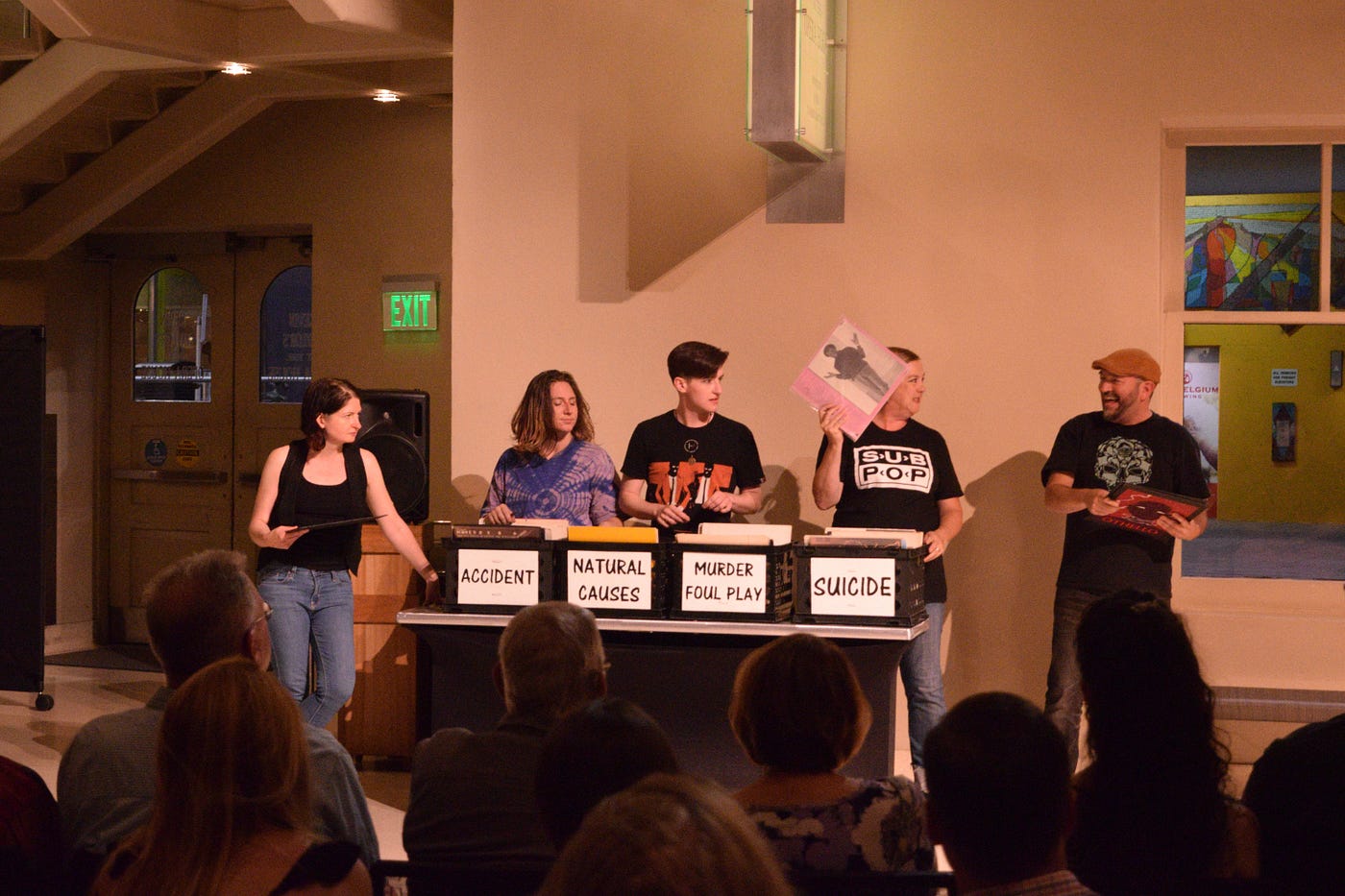
It’s here where we’re first introduced to the metaphysical record store and its motley crew of employees, the drunk and stoned groupies from the first act. They’re sorting records out of a “Recently Deceased” box into crates labeled Suicide, Natural Causes, Murder Foul Play and Accident, with exuberant commentary about who belongs in which crate and why. It’s meant to be a twist on the classic gravedigger scene in Hamlet, but I interpret the record store bit — which has a consistent presence throughout the play — to be much more like a Greek chorus, expressing to the audience what the main characters can not say. This tangential story arc ultimately exists to provides audience members with the contextual details of Cobain’s death that are necessary to understand the drama between Hamlet and Courtious as it unfolds. They also provide comedic relief and are overflowing with rock’n’roll trivia — crucial elements needed to successfully bring this Shakespeare tale into the mainstream.
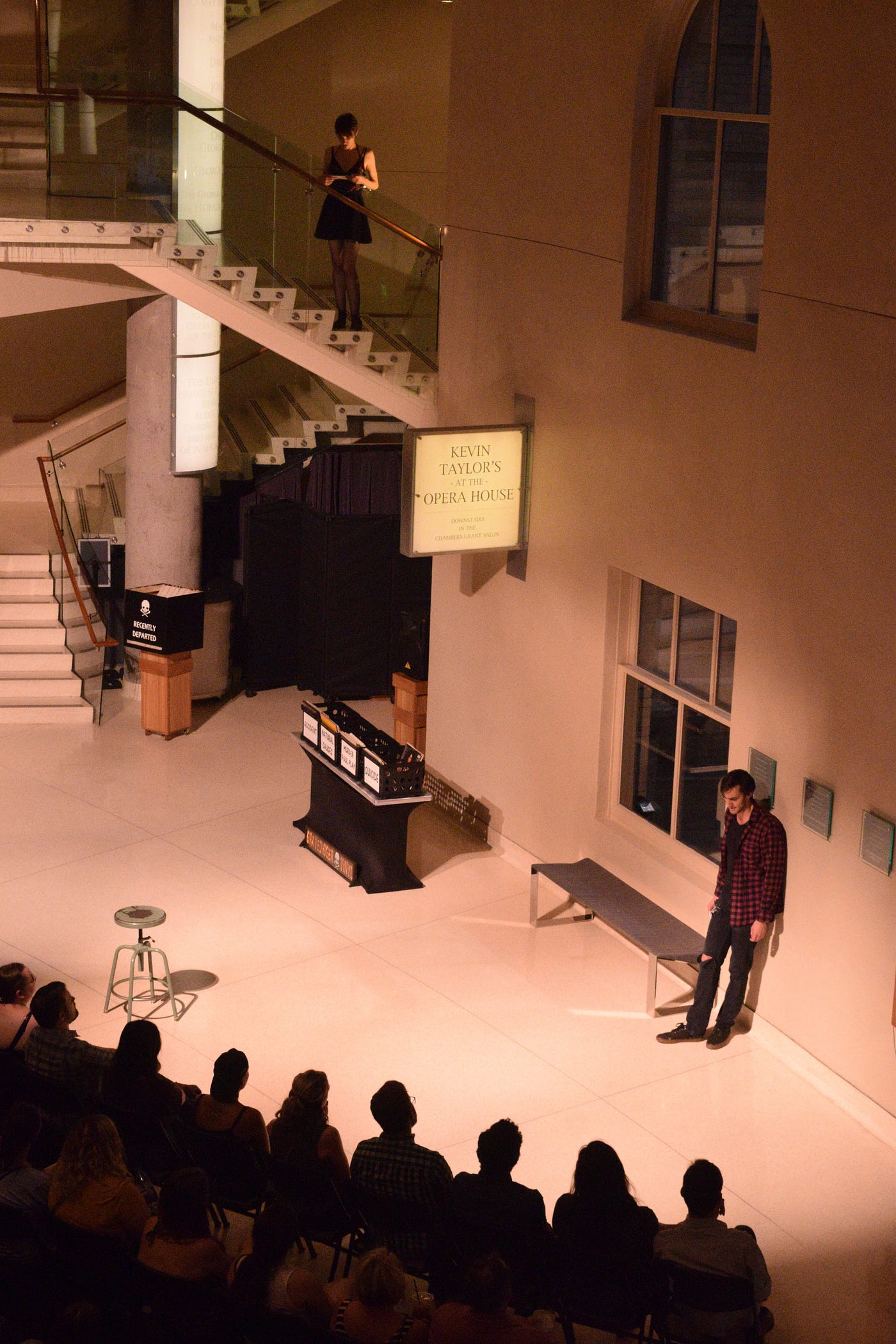
This second scene performance makes particularly good use of the unique elements of the space, such as the four flights of stairs in the back left corner. For example, we’re first introduced to the idea of Hamlet and Ophelia’s romantic interest as they flirt and exchange letters from different levels on the staircase, simulating the passing of time as they descend the stairs and continue to engage. Later, the vertical distance is used to create the effect of one character’s voice resonating inside another character’s head. In the same act, when Hamlet’s friends Rosencrantz and Guildenstern finally arrive to Elsinore, they peer inside at us through a floor-to-ceiling window, knocking rapidly and trying to get someone’s attention to let them in.
The middle section of Nirvamlet loses most of its immersive qualities as we move into the basement. It’s great acting and production quality, but the physical space doesn’t bring anything special or novel to the show. We, the audience, move to different seated areas throughout the basement as the play progresses, but it doesn’t achieve anything more than what a standard set change would on a standard theatrical stage.
We see several acts and have intermission in this basement space before it’s finally time to move on. The show begins to feel like a journey again as we next trudge down a long hallway with several guitar case memorials honoring influential rock icons who have passed. At the end of the hallway, we find Courtious crying, slumped over Cobain’s memorial.
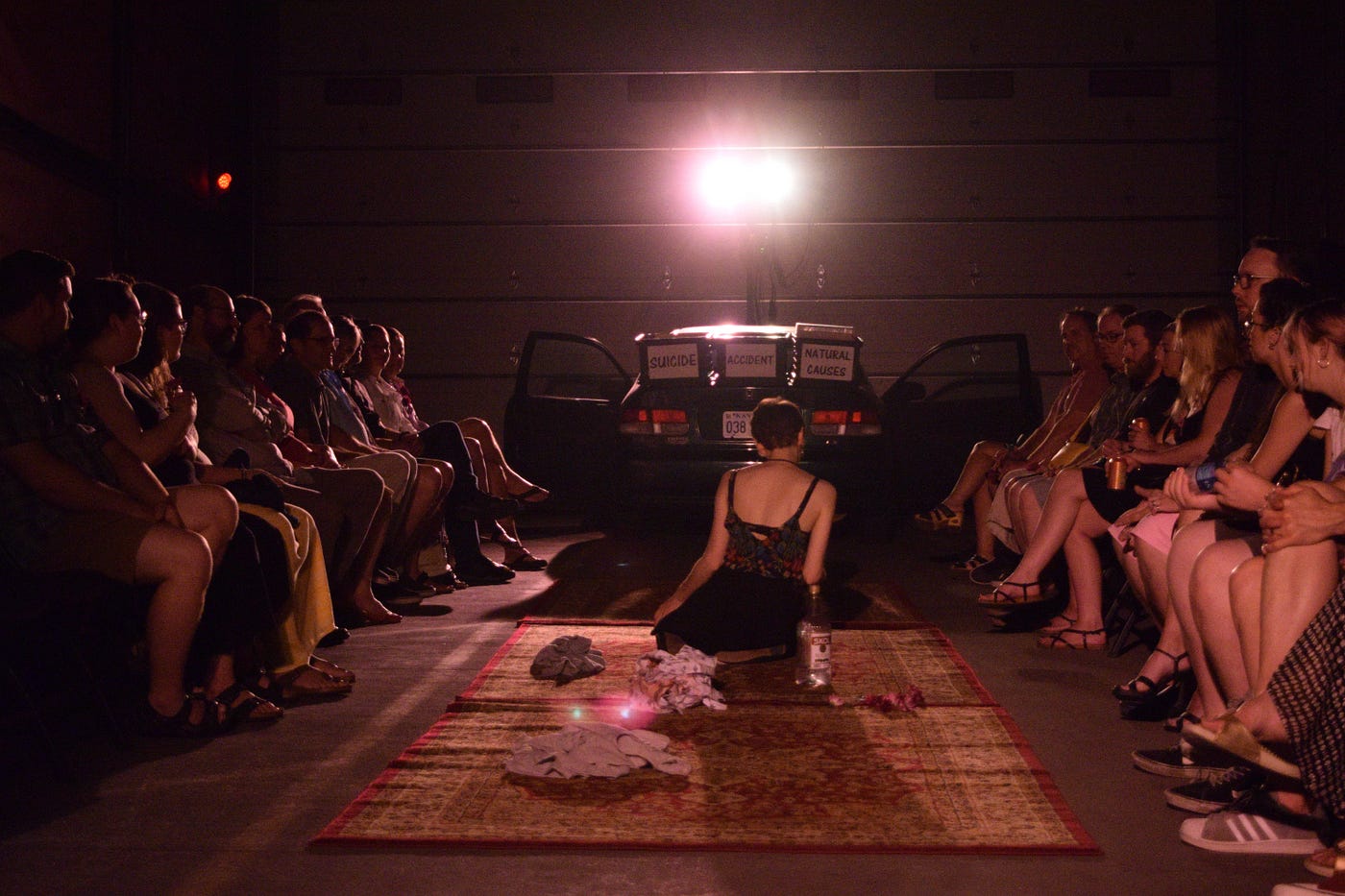
The finale brings us to a dark, ominous room with a giant downward slant to it. Both sides of the room are lined with chairs up and down the concrete ramp. A long red carpet runs down the middle, and the car from the beginning of the play is parked atop the ramp. We’re sitting on a loading dock for the Denver Performing Arts Complex, and it’s unquestionably the grungiest scene of the night.
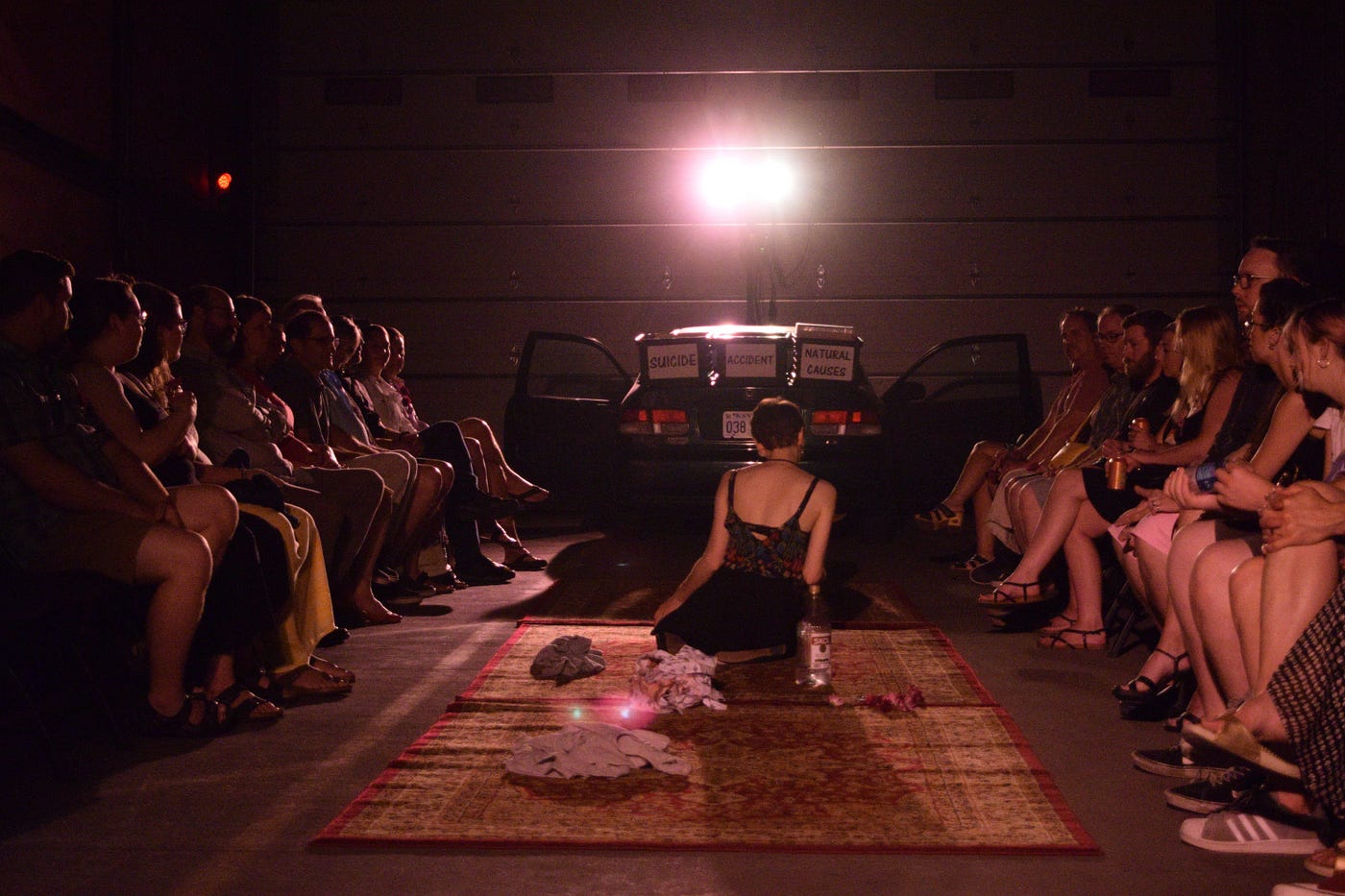
Here we are treated to one of the most genuine moments of the play as Ophelia, true to Shakespeare’s story, drowns herself (with vodka) in a striking solo performance. The final moments of the play are highly symbolic and meant to invoke contemplation around our culture’s obsession with celebrity status and death. We never actually arrive at a conclusion as to whether Cobain died by murder or suicide, and that’s okay. Detective Fortinbras, our guide and narrator for the night, sums it up best in his final dialog:
Fact or Fiction
Fiction or fact
Does this question even matter when the dead can’t come back?
Why do we hurt so much over losing our idols but barely shed a tear for our own kin?
Why do we have to live through legends just to be comfortable in our skin?
Do we all have a piece of the abyss within?
The writers and directors from Band of Toughs have designed Nirvamlet to be accessible to everyone, whether you know the story of Hamlet or not, and whether you support the conspiracy theory surrounding Cobain’s death or not. But I would argue that it’s best suited for audiences that do fall into those categories, and caution anyone who is not a Hamlet or Nirvana fan against buying tickets. The play is a novel experience, cleverly written and expertly performed. But it’s also riddled with references to these two intertwined stories, and you’ll miss a lot if you’re not at least casually familiar with the source material.
Nirvamlet ran June 14th — August 3rd at the Denver Center for the Performing Arts. Tickets were $24.


Discussion