



[Original publication: No Proscenium, 6/20/23]
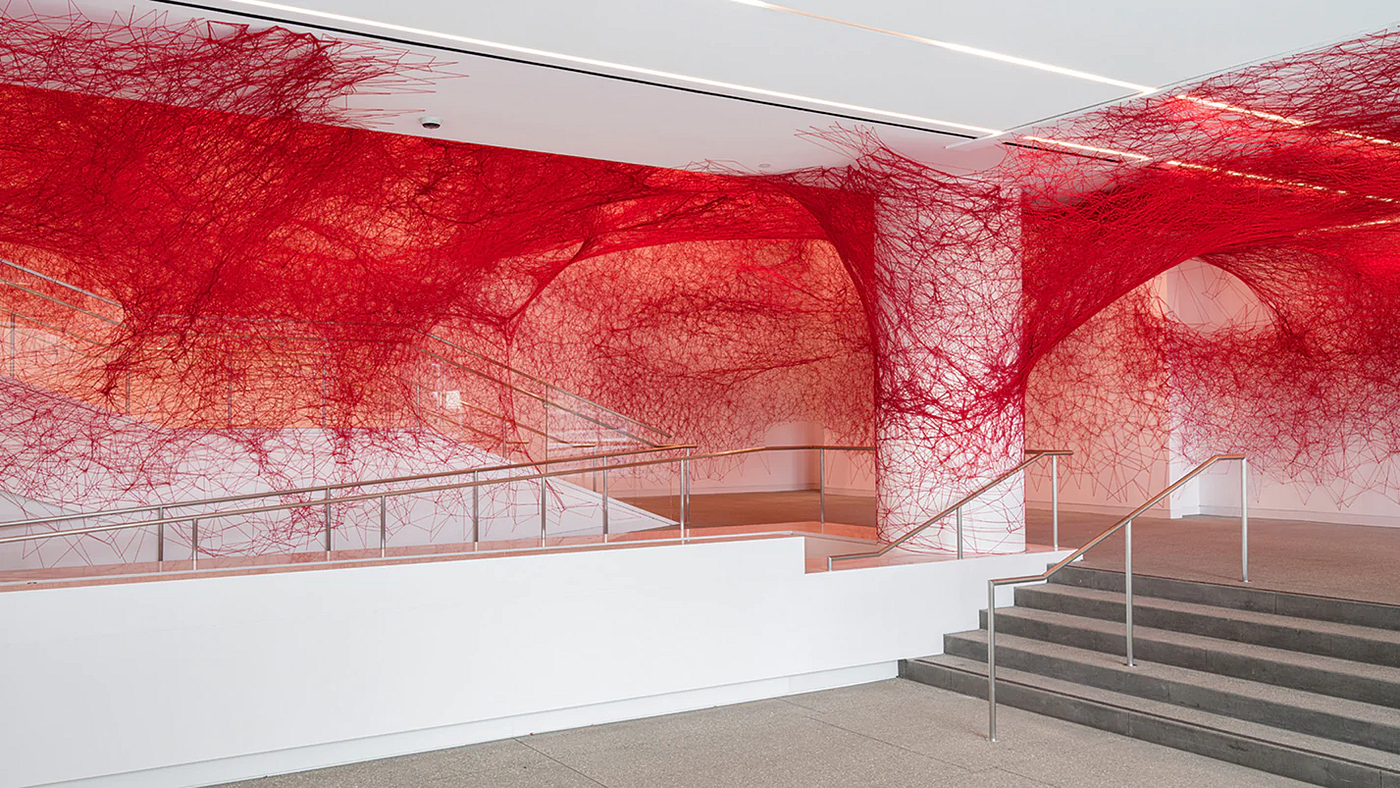
Like a thicket of veins.
Get Laura Hess’s stories in your inbox
Join Medium for free to get updates from this writer.
SubscribeSubscribe
That was my first thought when entering The Network, a voluminous installation by Japanese multimedia artist Chiharu Shiota. For decades her main material has been thread, at times interwoven with found objects like keys, suitcases, or even a charred piano. Her palette is unwavering: black, white, or red string. The Network’s crimson hue against the Hammer Museum’s white walls was immediately evocative of blood and vasculature.
Shiota has long explored ephemeral states such as memory, dreams, and emotions. Through density and its absence, she weaves a tangible, indescribable universality out of these intangible, personal processes. The result is all visceral response. Although thoughts come in — like the thicket of veins — they wash over and recede like a tide. What remains is a total, base sensation of intense physicality. It’s like smelling a forgotten scent from childhood; an instant, hallucinatory flashback of feeling without any cognitive effort, a complete bypass of thinking.
A site-specific sculpture created for, around, and through the lobby’s shapes, it is Kafkaesque and unlike anything commonly encountered inside a building. Ripe with tension, it’s a comforting cocoon and a nightmarish suffocation. On the heels of the popular video game and subsequent TV series The Last of Us, the threads are reminiscent of creeping fungal growth. It’s a transformational, transportive environment. With other art that can mean being transported away or sometimes it’s being transported within. The Network does both.
Shiota forages in uncomfortable places, amongst existential themes of mortality and “presence in absence.” In describing a period after her cancer diagnosis she said, “I was on a conveyor belt to death… and I did not know where to put my soul.” In her work spatial meaning isn’t confined to the corporeal. There’s a deep exploration of location within liminal phases and abstract concepts. The Hammer cites her invocation of “psychogeographic spaces.” Generally used in the context of urban landscapes and infrastructure, psychogeography is a kind of decoding, an examination of the “effects of the geographical environment… on emotions and behavior.” Shiota seems to apply this in both directions: geographical, physical constructs impressing on human emotions and emotional states embodied as physical constructs.
She has said, “The moment people enter my works, I want them to understand what it is to live and what it is to die.”
Isn’t this what we want most? To feel — even if it’s through the primal, harrowing acknowledgement of our own eventual death — unutterably alive?


Discussion